Does Body Doubling Work Without ADHD?
The short answer
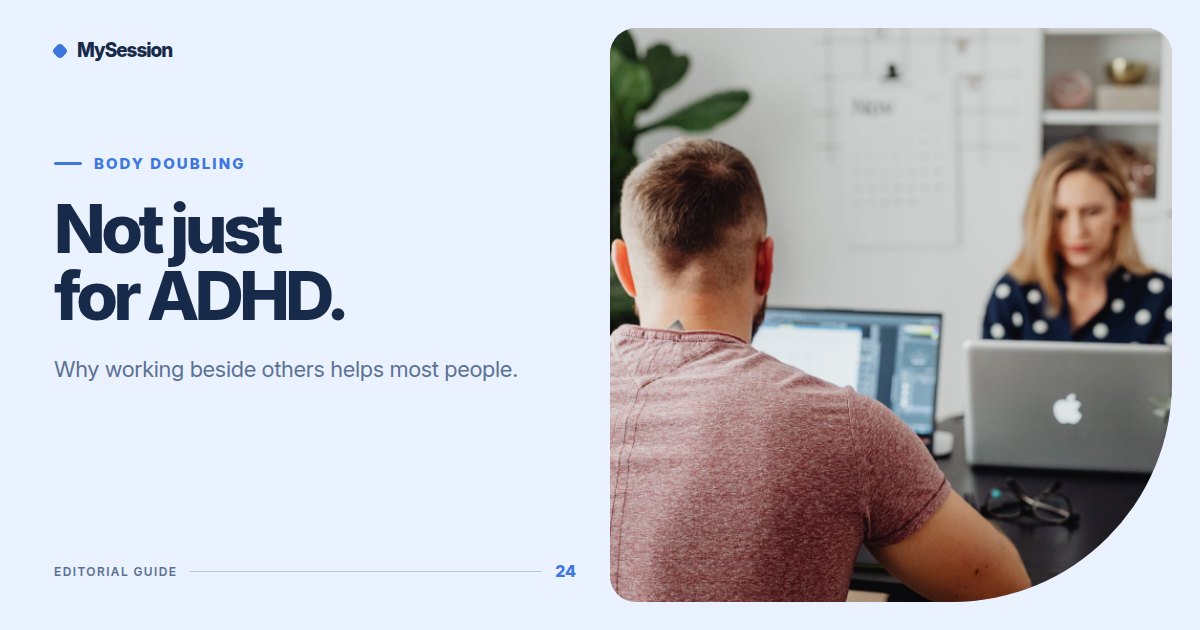
Yes. Body doubling, working on your own task while someone else is present and working on theirs, is not an ADHD-only technique. The term is usually traced to ADHD coaching, and people with ADHD talk about it most, but the reasons it helps apply to almost anyone: a clear start, a little social accountability, and a shared rhythm that makes it easier to keep going.
It does not help with every task, though, and it is worth knowing when it works best. This article explains what research on working around other people suggests, who tends to benefit, and how to test it for yourself in two weeks.
Why body doubling helps most people
Body doubling works through a few everyday mechanisms that have nothing to do with a diagnosis:
- A visible start. When a session begins at a set time with other people, the decision to start is made for you. For many people, starting is the hardest part of any task.
- Light accountability. Saying what you plan to do, out loud or in a chat, makes drifting away a little more noticeable, even if nobody checks on you.
- Social presence. Seeing other people work is a cue that this is a time for work. Offices and libraries rely on the same effect.
- A shared rhythm. A common timer for focus and breaks removes small decisions about when to stop, continue, or take a break.
None of these require ADHD. They are the reasons many people concentrate better in a café, a library, or a coworking space than alone at home.
What the research says, and what it does not
Psychologists have studied the effect of other people's presence for more than a century. In one of the first experiments, published in 1898, Norman Triplett found that adolescents wound fishing reels faster when working alongside someone than alone. Later research named this social facilitation.
The fuller picture is more nuanced. A 1983 review of 241 studies by Bond and Titus, covering nearly 24,000 participants, found that the presence of others had small effects overall: it tended to speed up simple or familiar tasks, while slowing complex tasks and reducing their accuracy. In practice that suggests body doubling helps most with work you already know how to do but keep avoiding, and less with brand-new, difficult material that needs your full working memory.
There is little controlled research on body doubling as a named technique, online or offline. Much of what we know comes from people's own reports and from surveys run by the companies that offer it, which are useful signals but not independent evidence. The honest conclusion is that body doubling is a low-cost, low-risk habit worth testing, not a guaranteed fix.
Who benefits without ADHD
People without ADHD use body doubling in many situations:
- Remote workers who miss the start-of-day cues and quiet company of an office. See our page on virtual coworking for remote workers.
- Students revising, writing essays, or working through problem sets, where a shared timer keeps a long session moving.
- Writers and creators who struggle to begin the first draft but work steadily once they have started.
- Anyone facing admin or chores, such as taxes, emails, cleaning, or forms: routine tasks where starting is the main obstacle.
- People going through a stressful period, when even familiar tasks feel heavier than usual.
When it helps less
Body doubling is a poor fit for some work. Learning something complex for the first time may go better alone, in line with the social facilitation research. Calls, meetings, or loud tasks do not suit a quiet room. And if being watched makes you anxious, a one-to-one video call can feel worse than working alone; a group room where cameras are optional, or simply working in chat, often feels easier. Our guide to group vs one-on-one body doubling covers the differences.
Test it in two weeks
You do not have to take anyone's word for it. Run a small experiment:
- Pick one type of task you often delay, such as writing, admin, or studying.
- For two weeks, alternate days: one day work alone with a timer, the next day work in a live focus room with the same timer length.
- After each session, note two numbers: how many minutes it took to start, and whether you finished what you planned.
- Compare at the end. If shared sessions start faster or finish more often, keep them for that kind of task.
If you want to compare platforms first, our roundup of the best body doubling apps lists free and paid options by format.
Frequently asked questions
Is body doubling only for ADHD?
No. It is popular in the ADHD community, but the mechanisms behind it, a visible start, light accountability, and social presence, help many people focus. Remote workers, students, and writers use it widely.
Is body doubling a treatment?
No. Body doubling is a practical focus technique, not a medical treatment. If you are struggling with attention, mood, or daily functioning, talk to a doctor or a qualified professional.
Does virtual body doubling work as well as in person?
There is not much direct research comparing them. Many people find that seeing others work on video, or simply knowing a group is working at the same time, gives a similar push. Try both and keep what works for you. Our guide to body doubling explains how online sessions run.