Group vs One-on-One Body Doubling: How to Choose
Two ways to work alongside someone
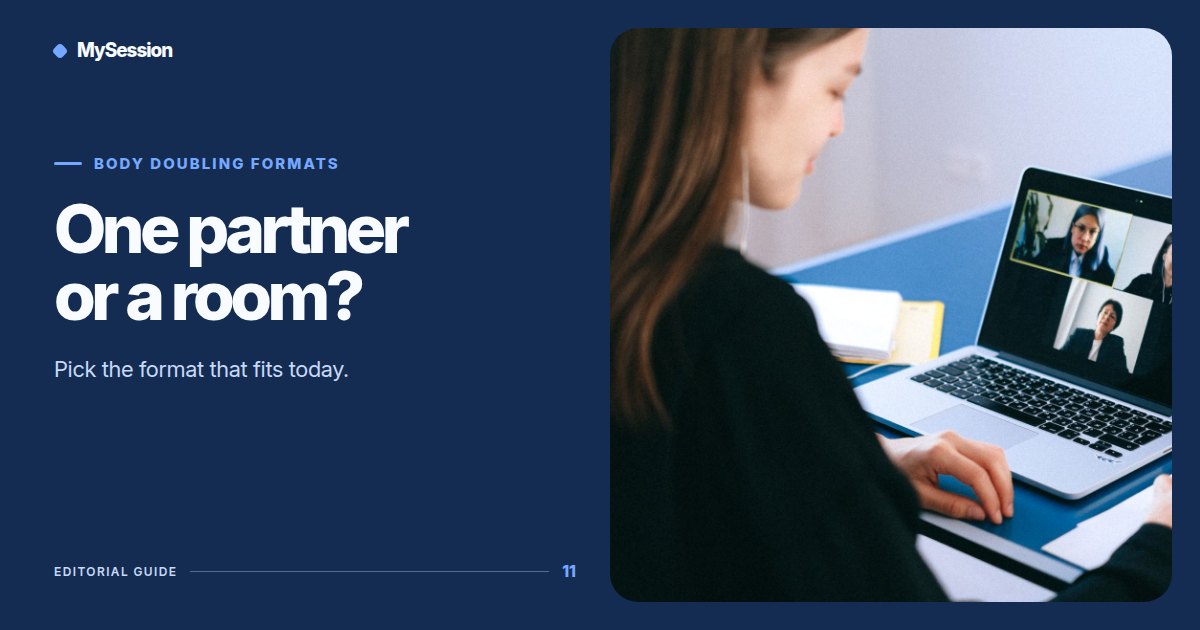
Body doubling means doing your own task while another person is present and working on theirs. Online, that presence usually comes in one of two shapes: a one-on-one session, where you are paired with a single partner, or a group session, where several people share one room and one timer.
Both formats use the same basic ingredients: a visible start, a stated intention, quiet work, and a check-in at the end. What changes is how much attention is on you, how easy it is to get in, and what happens when a session does not go to plan. If you are new to the idea, start with what body doubling is; this article assumes you already want to try it and need to pick a format.
What a one-on-one session feels like
In a one-on-one session, one other person sees your start and your finish. You tell each other what you plan to do, work quietly, then report back. Because there is only one partner, the commitment can feel personal: you are less likely to drift off when someone specific is expecting a short update.
The trade-offs are just as clear. You usually need a match or a booking, so the session starts at a set time rather than the moment you feel ready. A camera is often expected. If your partner is late or leaves, the session can feel empty. Some people also find the direct attention uncomfortable on a low-energy day.
On MySession, the 1:1 tab on the sessions page offers a matching queue, scheduled 50-minute slots, and a private link you can send to a friend. Camera is required for 1:1 sessions, and at the time of writing only 50-minute sessions are available. Booked 1:1 platforms work in a similar way; for example, Focusmate pairs you with a partner for booked 25, 50, or 75-minute video sessions (checked October 2026). Our Focusmate alternative page compares that model with group rooms in more detail.
What a group session feels like
In a group, the energy comes from the room rather than one person. You see several people settle into their own work, and the shared timer marks the same focus and break stages for everyone. No single person is watching you, which makes it easier to join on a day when you feel slow or distracted.
Groups also tolerate small disruptions. If someone leaves early, the room keeps going. You can usually write your intention in chat instead of saying it aloud, and some rooms keep the camera optional. The cost is a looser sense of personal commitment: nobody will notice in the same way if you quietly stop working, so a clear intention matters more.
MySession offers two kinds of group room: scheduled sessions with a fixed start time and timeline, and always-open rooms with a repeating structure. Read scheduled vs drop-in focus sessions if you are unsure which of those to try first.
A quick way to decide
| If this sounds like you | Try |
|---|---|
| You do your best work when one specific person expects an update | One-on-one |
| You feel watched or self-conscious with a single partner | Group |
| You want to start right now, without waiting for a match | Always-open group room |
| You need a fixed appointment to show up at all | Scheduled group or booked 1:1 |
| You prefer to keep your camera off | A group room whose rules allow it |
| You want to work with a friend at a set time | A private 1:1 link |
None of these rows is permanent. Many people use a one-on-one session for the task they keep avoiding and a group room for routine work. Your energy, your environment, and the task itself can all change which format helps.
Make either format work better
Write the intention before you join. "Answer five emails and archive the rest" survives a distraction better than "do email." Our guide to writing a focus session intention has examples.
Pick the session length deliberately. A shorter block helps when starting is the problem; a longer one protects context for writing or design. See choosing a 25, 50, or 90-minute focus block.
Keep private details out of the room. In either format, you can name the outcome without naming the client, the document, or the person involved.
Review after three sessions, not one. One awkward session does not prove a format is wrong. After three, compare which sessions you actually started and finished, then adjust.
The honest bottom line
One-on-one body doubling gives you stronger personal commitment at the cost of scheduling and visibility. Group body doubling gives you easier entry and less pressure at the cost of a looser sense of being expected. Choose the format that removes today's obstacle, then find a session and start with one small, checkable outcome.